
Facts About Parkinson’s Disease
- Affects approximately 1 in 500 people worldwide.
- Around 1 million people are living with Parkinson’s Disease.
- Approximately 1 in 350 people have Parkinson’s in Australia.
- Most diagnoses occur after age 60.
- Men are about 1.5 times more likely to develop Parkinson’s Disease than women.
What is Parkinson’s Disease?

Parkinson’s disease (PD) is a neurodegenerative disorder that affects movement. It majorly affects the nervous system part of the brain that controls movement. It is a progressive disease, meaning it keeps on getting worse as the days go on. Parkinson’s disease symptoms start gradually, sometimes starting with a simple tremor in just one hand. Parkinson’s disease has no cure, but some medications can ease the symptoms.
Its symptoms occur due to low dopamine levels in the brain. Scientists do not know where this disease originates from. However, some argue that genetic changes and exposure to toxins contribute to its development. If you have Parkinson’s disease, you may shake, have muscle stiffness, and experience trouble when walking. You may also endure difficulty in maintaining your balance and muscle coordination.
As the disease worsens, you may experience difficulty in talking and sleeping. Mental and memory problems also manifest with additional behavioural changes. Parkinson’s disease affects 50% more men than women. It is also very common in people above 60 years of age. However, about 10% of people with Parkinson’s disease are diagnosed before they reach 50 years.
What Are the Stages of Parkinson’s Disease?
According to scientists and health experts, Parkinson’s disease falls into four stages. Each stage manifests different signs and symptoms as the disease progresses.
Early-stage
This stage of the disease has mild symptoms which occur slowly. These symptoms also do not affect the activities of daily living. Sometimes it’s very hard to notice any changes. Many people confuse early signs of Parkinson’s disease with signs of aging. People in this stage may experience fatigue or general symptoms of uneasiness. They can also have mild tremors and difficulty while standing.
Mid Stage
In this stage, the symptoms get worse. Individuals with Parkinson’s disease experience muscle stiffness and tremors. They also have movement difficulties which affect both sides of the body. People with Parkinson’s suffer from falls and balance issues more often than before when in this stage. People can live normally but activities of daily living i.e., bathing, dressing, and cooking may be difficult to perform. These people also take longer to complete simple tasks that they were previously doing at a faster rate.
Mid-Late Stage
This stage makes it difficult to stand and walk. People with Parkinson’s disease become unable to walk. As a result, they may require a walker to help them move from one place to another. They may also need a full-time helper to assist in performing some chores while living at home.
Advanced Stage
This is the last stage of Parkinson’s disease. The condition gets worse, making it extremely hard to walk, stand, or even move. This stage exposes individuals to many occurrences of delusions and hallucinations. Anyone in this stage requires a full-time nurse or a caregiver at home. If the symptoms worsen, patients can be taken to nursing homes for better management of symptoms. Here is an elaborate explanation of the types of Parkinson’s disease: https://shorturl.at/IU0ZX
What Are the Symptoms of Parkinson’s Disease?
Changes in speech
Parkinson’s disease causes gradual loss of dopamine-producing neurons in the brain. These neurons affect the brain regions controlling movement and coordination. With time, the disease triggers reduced muscle control in the vocal cords. This causes individuals with Parkinson’s to have slurred, or monotone speech. They may also speak too quickly or too slowly and experience slurs or hesitation before talking.
Changes in posture and balance
As the disease progresses, it causes motor control impairment and muscle rigidity. As a result, the individuals end up having a stooped posture. These people are also prone to falling as the disease makes finding balance difficult.
Bradykinesia
This is a term used to describe slowing down of the voluntary movements in a person. Bradykinesia makes performing simple tasks such as speaking or even brushing teeth difficult. While attempting to walk, the steps may become shorter, making individuals drag their feet, and become unable to get out of a chair.
Micrographia
This is difficulty in writing and occurs as a result of bradykinesia and muscle rigidity. People with micrographia secondary to Parkinson’s disease have handwriting that appears smaller and illegible.
The rigidity of the muscles
The disease causes stiffness of the muscles. This stiffness can affect any muscle in the body, causing difficulty in movement. Muscle stiffness also causes a lot of pain and discomfort, which contributes to further movement cessation.
Tremors
The disease can begin with a simple tremor of one hand or foot. Most often, people may not realise it until a relative or a friend spots a sudden shake. These tremors usually occur at rest and are worsened by factors like fatigue, or stress
Automatic movement impairment
There are various things that the human body can do automatically, like blinking, smiling, or swinging your arms when walking. In people with Parkinson’s, all these autonomic movements are impaired and may be hard for patients to express them.
Dystonia
This is when an individual experiences abnormal and prolonged muscle contractions. This may make someone experience painful cramps on the feet and have clenched toes. Dystonia occurs in any part of the body, causing spasms twisting of the muscles, and pain.
What Causes Parkinsonism?
Until today, the exact cause of Parkinson’s disease is unknown. However, several factors have proven to play a part in the development of Parkinsonism, including:
Low levels of dopamine
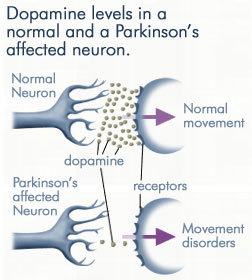
Dopamine is a neurotransmitter that is involved in regulating many functions. One of its major functions is sending messages to the parts of the brain that control movement and coordination. In Parkinson’s disease, the cells that produce this dopamine die, making its production low. In return, this causes irregular brain activity which creates movement problems seen in Parkinson’s disease.
Lewy bodies
People with Parkinsonism may have clumps of certain proteins called alpha-synuclein or Lewy bodies, particularly in their brains. Scientists believe that when these proteins accumulate, they cause the loss of nerve cells. This leads to a gradual loss of movement, thinking, behaviour and even mood.
Genetics
We are all products of genes that we inherited from our parents, right? Scientists argue that some genes found in certain people predispose them to Parkinsonism. However, they don’t consider it a condition that can be inherited. In all cases of Parkinsonism, only 10% are directly linked to genetics
Low norepinephrine levels
Parkinson’s disease causes damage to the nerves that produce another neurotransmitter called norepinephrine. This chemical is essential in regulating blood circulation and other automatic body functions, like blinking and smiling. When this chemical is low, it causes rigidity, stiffness, and postural difficulties.
It also leads to tremors, dementia, depression, and difficulty focusing. These symptoms cause orthostatic hypotension where there is a sudden drop of blood pressure when standing. Individuals with orthostatic hypotension are usually at a risk of falling when standing and can sustain injury or even die.
Some autoimmune diseases
In 2017, scientists found a direct link between Parkinson’s disease some certain types of autoimmune disorders. A good example of such a condition is rheumatoid arthritis. In 2018, the same research conducted in Taiwan found that people with rheumatoid conditions have a 1.37 higher chance of also having Parkinson’s disease. Here are full details concerning this research: https://shorturl.at/613Iy
Parkinson’s Disease Treatments: Comprehensive Guide to Managing Symptoms
Medications
Parkinson’s Disease has no cure. However, there are several effective treatments available to manage its symptoms and improve quality of life. These medications primarily work by increasing or substituting dopamine levels in the brain. They include:
Carbidopa-Levodopa
Currently, Levodopa remains the most effective medication for Parkinson’s disease. The drug works by converting to dopamine in the brain. When Carbidopa is combined with levodopa, it works to prevent early conversion of levodopa to dopamine outside the brain. This prevents occurrences of nausea. These drugs cause nausea, lightheadedness (orthostatic hypotension), and, over time, wearing off and dyskinesia (involuntary movements).
Inhaled Carbidopa-Levodopa (Inbrija). This drug offers quick relief when the oral medications stop working during the day.
Carbidopa-Levodopa Infusion (Duopa). This combination is administered through a feeding tube directly into the intestines. This is given to individuals with the advanced stage of Parkinson’s disease. Its major side effect is a risk of infections and tube falling out or coiling.
Dopamine Agonists
These drugs act by mimicking dopamine effects in the brain. When compared to Levodopa, dopamine agonists are less effective. Examples of these drugs are pramipexole (Mirapex ER) and rotigotine (Neupro), which is given as a patch. Apomorphine (Apokyn) is a short-acting dopamine agonist shot used for quick relief. People taking dopamine agonists may experience hallucinations and sleepiness. They may also experience compulsive behaviours like hypersexuality, gambling, and eating.
Monoamine Oxidase B
This category of drugs works by inhibiting the action of monoamine oxidase B (MAO B). MAO B is a brain enzyme that breaks down dopamine, making it less effective. Therefore, these drugs prevent dopamine breakdown, making it available for use in the brain. Examples of MAO B Inhibitors are selegiline (Zelapar), rasagiline (Azilect) and safinamide (Xadago). Individuals taking these medications experience constant headaches, nausea and insomnia. The drugs also expose them to a higher risk of developing hallucinations when MAO B Inhibitors are combined with carbidopa-levodopa.
Catechol O-Methyltransferase (COMT) Inhibitors
These drugs work by prolonging the effect of levodopa by blocking its breakdown. However, they cause dyskinesia, diarrhea, nausea, and vomiting.
Anticholinergics
In Parkinson’s disease, anticholinergics are used in people experiencing severe tremors. They have side effects such as memory impairment, confusion, hallucinations, and constipation.
Amantadine
This is an effective drug that provides short-term relief during the early stages of the disease. In later stages, the drug is used to control dyskinesia. Amantadine causes skin colour changes, ankle swelling, and hallucinations.
Adenosine Receptor Antagonists
This drug helps to regulate dopamine release in the brain.
Nuplazid
Scientists do not understand the exact mechanism of action of this drug. However, it is used to treat hallucinations and delusions specific to Parkinson’s.
What Are Preventative Measures for Parkinson’s Disease?
Currently, it’s not possible to prevent, cure, or stop the development of the disease. However, there are lifestyle modifications that you can adopt to help reduce the risks. They are:
Avoid exposure to toxins
Some of the toxins are found in herbicides, pesticides, and solvents. To limit the exposure, you can choose an alternative like paraquat that has fewer toxins and also wear protective clothing when using chemicals. Here is how toxins expose you to Parkinson’s disease: https://shorturl.at/vZB2W
Avoid trauma
Head trauma has been highly linked to Parkison’s disease. Try to protect your brain from injury by:
- Wearing protective headgear when working in injury-prone areas.
- Wearing helmets when cycling.
- Use a safety belt when in the car.
- Seeking immediate medical treatment after a sudden concussion.
Exercise
A study conducted in 2018 showed that exercising daily may help to prevent or treat the symptoms of Parkinson’s disease. This is because exercise may help keep dopamine levels in your brain.
Dietary modifications to prevent Parkinson’s disease
Choosing some diets may lower your risk of developing the disease. For example, you can take:
- Turmeric. It contains curcumin, an antioxidant ingredient that helps prevent symptoms of Parkinson’s disease. It prevents stress and clumping of proteins in the brain.
- Flavonoids. These are found in berries, apples, tea, some vegetables, and red grapes. Research suggests that they contain antioxidants that may help prevent the disease.
Avoid aldehydes. Some cooking oils such as sunflower oils, when heated, may contain aldehydes. Aldehydes are toxic and produce toxic chemicals linked to Parkinson’s disease.
To Sum Up
Parkinson’s disease is a lifelong condition that affects the nervous system. It causes changes in movement and muscle cramping. Scientists don’t understand how it develops, but it is highly linked to genetics and environmental factors. Past traumatic brain injuries and exposure to two toxins are two strong leads that scientists believe can trigger the disease. Exercise, avoiding toxins, and dietary modifications can help reduce the chances of developing the disease. The disease cannot be cured, but the symptoms can be prevented from worsening and reducing the quality of life.
 Palene Health