
Graves’ disease, a common cause of hyperthyroidism, is an autoimmune disorder that leads to an overactive thyroid. Learn about symptoms, causes, and treatment options for this condition.
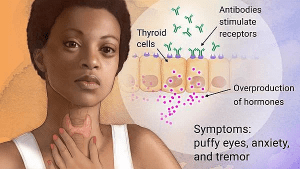
Image from:https://shorturl.at/R2eqo
Graves’ disease is an autoimmune disorder. Graves’ disease affects your thyroid gland, a butterfly-shaped organ found at the front area of your lower neck. Your thyroid gland is responsible for producing the hormones tri-iodothyronine (T3) and thyroxine (T4). T3 and T4 help the body regulate vital functions like sleep, mental health, fertility, body temperature, growth and development, and heart rate.
Therefore, having Graves’ disease means that the thyroid gland is impaired and cannot accomplish these functions. If you’re diagnosed with Graves’ disease, your thyroid produces more excess hormones than your body requires. This overproduction leads to hyperthyroidism, a condition that causes your body’s metabolism to speed up.
Hyperthyroidism mostly occurs during middle adulthood but can also happen at any age. The disease affects 3% of the population and it’s 7-8 times more likely to affect women than men. Its peak age is between 40-60 years of age. Grave’s disease is the number one cause of hyperthyroidism.
What Causes Graves’ Disease?
The exact cause of Grave’s disease is unknown. However, the disorder develops when the immune system malfunctions. Ideally, the body’s immune system produces proteins known as antibodies to fight against foreign invaders like bacteria and viruses. In Grave’s disease, your body’s immune system creates thyrotropin receptor antibody (TRAb). Within the TRAb exists a sub-type called Thyroid Stimulating Immunoglobulins (TSIs), which stimulates the thyroid gland.
Instead of the body producing antibodies that target specific invaders, the immune system by mistake produces TSIs. The TSIs then target your healthy thyroid cells. The TSIs bind to your thyroid cell receptors, which are typically where Thyroid-Stimulating Hormone (TSH) attaches itself. The invading TSIs trick your thyroid into growing excessively and therefore release so many thyroid hormones, causing hyperthyroidism.
What Are the Signs and Symptoms of Graves Disease?
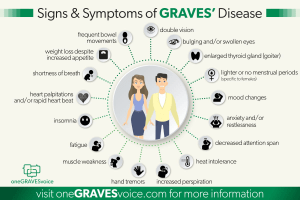
Image from:https://shorturl.at/Ua66w
In most cases, signs and symptoms of Grave’s disease differ from individual to individual. During the early stages of the disease, these symptoms are often mistaken for symptoms of other diseases, therefore delaying the diagnosis and treatment. common early symptoms include:
Weight loss despite increased appetite. Why? Because of a faster metabolism that does not encourage the storage of any glucose in the body.
Tremors especially in the hands or fingers
Heat intolerance and sweating are characterised by warm and moist skin.
Chest pains, palpitations, and irregular heartbeats.
Shortness of breath and difficulty in breathing.
Muscles, weakness, and fatigue
Restlessness, irritability, anxiety, and mood swings.
Difficulty sleeping and disturbed sleep.
Increased stool frequency with or without diarrhoea.
Reduced libido in women and erectile dysfunction in men.
Vitamin B12 deficiency.
Bulging eyes, also known as Graves’ ophthalmopathy. This is a thyroid eye disease.
Thick, discoloured skin, particularly on the shins or the tops of the feet. This is called Grave’s Dermopathy
Goiter is a condition characterised by an enlarged thyroid gland, often visible as a swelling at the base of the neck.
Risk Factors for Graves’ Disease
Grave’s disease has many risk factors including:
Family History. An individual with a family history of thyroid or autoimmune conditions is more likely to develop Grave’s disease.
Gender. Research shows that Grave’s disease affects women more than men.
Age. Most commonly affects individuals between 30 and 60 years old.
Other Autoimmune Conditions. Having other conditions related to autoimmunity such as type 1 diabetes or rheumatoid arthritis increase the risk.
Smoking. Cigarette smoking can affect the immune system and increase the risk of both Graves’ disease and thyroid eye disease
How is Grave’s Disease Diagnosed?
Once you have visited a hospital, the doctor may recommend the following tests based on your symptoms.
Blood tests. These tests evaluate the levels of TSH in the bloodstream. TSH is a pituitary gland hormone that tells your thyroid gland to produce thyroid hormones. In Grave’s disease, TSH is usually lower than normal and the thyroid hormone levels are elevated.
A blood test can also measure TRAb for accurate diagnosis.
Radioactive iodine uptake. Ideally, your body uses iodine to make thyroid hormones. In this test, an individual is given a small amount of radioactive iodine to measure the rate at which the body absorbs it.
Ultrasound. An ultrasound uses high-frequency sound waves to produce images of the thyroid gland. This will show if you have an enlarged thyroid, which could mean you have Grave’s disease.
What is the Treatment for Grave’s Disease?
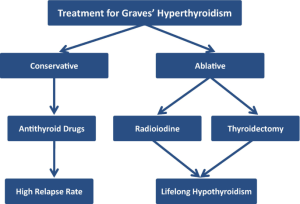
Image from: https://shorturl.at/WBUs8
The principal goal of treatment is to stop the overproduction of thyroid hormones and their effects on your body. You can consider the following treatment options:
- Radioactive iodine therapy. Doctors give this as a small single pill. When this pill is swallowed, the radioactive iodine enters your bloodstream and is absorbed by the overactive thyroid cells. In the end, the thyroid shrinks, and your levels of thyroid hormones return to normal.
- Anti-thyroid medications. These drugs are also called antithyroid agents. They work by blocking the ability of your thyroid gland to produce new thyroid hormones. An outstanding example of these drugs is methimazole which is preferred because of its reduced side effects to the liver. Another one is propylthiouracil.
- Surgery. Sometimes thyroidectomy surgery can be performed where other treatment options are not effective. The procedure involves the removal of all or most of the thyroid gland. This surgery can also affect the parathyroid glands that regulate the production and absorption of calcium. It can also affect the nerves that control your vocal cords.
- Beta-blocker medications. Your doctor may prescribe beta-blocker medications. These drugs do not affect your thyroid hormone levels but can help slow your heart rate and reduce other symptoms like nervousness and tremors.
What Are the Complications of Grave’s Disease?
When an individual fails to get the right treatment, Grave’s disease triggers complications such as;
Goitre. Without treatment the thyroid gland continues to grow, making it appear swollen. This enlarged thyroid gland as a result of Grave’s disease is known as diffuse thyrotoxic goitre. With time, the swelling causes coughing, difficulty in swallowing, and disrupted sleep.
Thyroid eye disease (TED). The eye problems linked to Grave’s disease are known as Grave’s ophthalmopathy or TED. It occurs in over 30% of people with hyperthyroidism and can run from mild to severe. Its characteristics include red eyes, tearing, a feeling of sand or dust in your eyes, and light sensitivity.
As the disease progresses, it can worsen to cause bulging of the eyes, a condition known as exophthalmos. This happens when Grave’s disease triggers an inflammation of the eye muscles, hence making the muscles and tissues swell. As the eye orbits continue to swell, they push the eyes forward, making someone look as if he/she is staring. Learn how you can prevent or treat thyroid eye disease here:https://shorturl.at/dmZna
Skin thickening. Some people suffering from Grave’s disease may end up developing thick skin. They can also have skin lesions that appear to be patchy or pink. They mostly develop in the front of the legs and feet. This condition is also called pretibial myxedema.
Thyroid Storm. This is a rare but life-threatening condition where a sudden surge in thyroid hormones causes fever, sweating, confusion, severe weakness, tremors, irregular heartbeat, severe low blood pressure, and coma. This requires immediate medical attention.
Osteoporosis. Long-term untreated hyperthyroidism can lead to brittle bones due to difficulty in maintaining adequate calcium levels in the bones.
Pregnancy Issues. Graves’ disease during pregnancy can lead to miscarriage, premature birth, fetal thyroid issues, and poor fetal growth. It can also cause heart failure and preeclampsia in the mother.
Heart Conditions. Untreated Graves’ disease can result in irregular heart rhythms and heart failure. This happens as a result of the heart failing to pump enough blood to the rest of the body.
Frequently Asked Questions (FAQs).
- What causes Graves’ disease?
The exact cause of Graves’ disease is unknown, but it involves the immune system producing an antibody called thyrotropin receptor antibody (TRAb) that over-stimulates the thyroid gland, leading to excessive hormone production.
- Can Graves’ disease be cured?
There is no cure for Graves’ disease, but treatments can effectively manage symptoms and control the overproduction of thyroid hormones. Some treatments, like radioactive iodine therapy or surgery, can lead to long-term remission.
- Can Graves’ disease affect pregnancy?
Yes, Graves’ disease can impact pregnancy, leading to complications like preeclampsia, premature birth, and thyroid problems in the baby. Pregnant women with Graves’ disease need to work closely with their healthcare provider to manage the condition.
- What disease is Vybz Kartel suffering from?
Vybz Kartel, the dancehall star, is suffering from Graves’ disease, an autoimmune disorder that affects the thyroid. This condition, coupled with two serious heart conditions, has made his situation life-threatening. His Graves’ disease has not gone into remission over the past seven years. The disease causes symptoms such as swelling of the face and protruding eyes, which have worsened due to the harsh conditions of his imprisonment.
 Palene Health